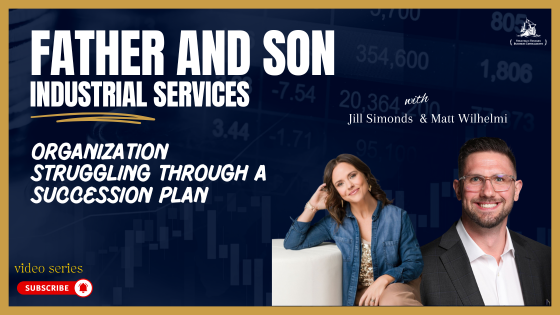

It was an absolute pleasure having a series of in-depth conversations with Jill Simonds, the founder & CEO of Savvy Strategic Partners ????️✨ Jill is a powerhouse when it comes to helping businesses overcome operational challenges and achieve their full potential. With over a decade in marketing and a master’s in organizational leadership, she’s a fractional COO who specializes in creating clarity and accountability across B2B organizations. ????????????
This exciting conversation is hosted by Matt Wilhelmi, owner of Strategic Voyages Business Consultants and author of “Taboo Business Questions: What’s Haunting Every Entrepreneur’s Growth.”
Jill Simonds and Matt Wilhelmi – Episode 1
Episode 1 begins with Jill’s Background and then dives into an exciting Case Study!
???? The Case Study: A Family-Run B2B Company Facing Growth Challenges ????
A flat organizational structure, multiple locations, and ambitious growth goals — but also facing critical obstacles:
- ❌ Lack of Accountability & Structure: Confusion over who owns what, leading to inefficiency.
- ❌ Unclear Leadership & Decision-Making: A lack of defined roles made it tough to scale and caused bottlenecks.
- ❌ Inability to Scale Effectively: No clear path to grow due to missing frameworks for future development.
Jill’s Approach to Diagnose the Root Causes ????️♀️:
- Undefined Organizational Structure: The absence of a clear accountability chart and role definitions led to gaps in task ownership and operational inefficiencies.
- Misalignment on Growth Objectives: There was no structured plan for the current state and future state of the organization’s growth and how the required human capital would align with these goals.
- Lack of Performance Measurement: The company was not using key performance indicators (KPIs) or other measurement tools to gauge progress or effectiveness in each role and department.
If you’re seeking insight into operational challenges or looking to scale your business sustainably, Jill’s expertise is not to be missed. ????
Jill Simonds and Matt Wilhelmi – Episode 2
Cautionary Tales and Lessons Learned ????????
2. Who’s in Charge: A Partnership Dilemma
1. From Rocket Start to Crash Landing: A Tech Company’s Inaction
Overview: Horizon Tech, a software service startup, initially saw significant growth with a lean and agile team. However, as the company expanded, it failed to establish a clear operational structure and resisted change, believing that what worked in the past would continue to serve them. The team experienced growing pains, lacked clear accountability, and suffered from unproductive meetings, which contributed to stalled growth and wasted resources.
Lesson Learned: The company’s attempt to introduce various tools and systems without coherent strategy led to chaos, complacency, and inefficiency. The lack of discipline and failure to focus on the root causes of their issues, such as the need for structure and streamlined operations, resulted in financial stalls and rising operational costs. This highlights the importance of prioritizing change and implementing systematic processes rather than overwhelming the team with uncoordinated solutions.
2. Who’s in Charge: A Partnership Dilemma
Overview: Matt Wilhelmi shares a story of two young founders who were 50/50 partners in their business but did not have any formal documentation or structure to clarify responsibilities or decision-making. Eventually, one partner unilaterally took an 80% ownership stake, claiming the other wasn’t contributing enough. This situation led to frustration, lack of direction, and an imbalanced power dynamic, ultimately hurting the partnership and the business.
Lesson Learned: Lack of structure and formal agreements can quickly derail partnerships, even with driven and motivated individuals. It’s crucial to have clear role definitions, responsibilities, and an accountability chart to avoid ambiguity. Ensuring proper operating agreements and a system for decision-making and conflict resolution can prevent one-sided decisions and maintain business harmony.
3. Sky High Early Success to Flying Blind: The Pitfalls of Not Measuring Performance
Overview: Rising Star Agency, operating in a niche celebrity market, saw rapid revenue growth and early success. However, beyond top-line revenue and profit, they lacked an aligned accountability system for other metrics that were critical to sustained business health, like client retention and service quality. The founder-led business lacked standardized processes for service delivery and performance, leading to client churn and operational challenges.
Lesson Learned: The agency’s hyper-focus on revenue without tracking leading performance indicators contributed to their downfall. Jill emphasizes the importance of implementing a scorecard with measurable KPIs beyond just financial metrics to maintain long-term success. A scorecard provides visibility into operational health, employee performance, and client satisfaction, ensuring that scaling up is done in a controlled and sustainable way.
Jill Simonds and Matt Wilhelmi – Episode 3
In this episode, Jill Simonds joins Matt Wilhelmi, Sr. Consultant with Strategic Voyages Business Consultants and author of Taboo Business Questions, to present her solutions to the case study discussed in Episode 1.
Case Study Review:
Matt Wilhelmi introduces a case study of a family-owned business in the B2B restaurant service industry based in Arizona. The business has over a thousand clients and multiple crews servicing those clients. The father-son duo running the business faced operational challenges, particularly around succession planning, role clarity, and accountability. The father would take long, extended trips, leaving the son to manage operations without a defined structure or guidance, leading to inconsistencies in leadership and operational inefficiencies.
Matt was introduced to the organization through a banker who saw an opportunity for improvement. The organization lacked fundamental business systems, such as an ERP, and relied heavily on spreadsheets for managing its operations, contributing to a chaotic and inefficient workflow. Additionally, the dynamic between the father and son created confusion and tension among employees about decision-making authority and the overall direction of the company.
Jill Simonds’ Approach to Diagnosing Issues
Jill’s method for diagnosing such challenges involves several steps:
Assessing Core Business Components: Jill looks at key areas like vision alignment, data and KPI tracking, process standardization, team accountability, and people management. For example, she identifies whether there’s a shared vision across the company, whether the data and KPIs are used effectively to track performance, and if the organization has defined and adhered to standardized processes.
Clarifying Leadership and Accountability: Understanding who is truly in charge and whether there is a clear delineation of roles and responsibilities, especially in a complex family business dynamic.
Engaging in Deep Discussion: Using the EOS model of “Identify, Discuss, and Solve” (IDS), Jill works to ask probing questions to uncover the root of symptoms. This includes questions about decision-making processes, role clarity, team dynamics, and succession planning.
Jill’s Recommended Solutions:
1. Establish an Accountability Chart
- Solution Overview: Jill recommends creating an accountability chart that clearly defines each role and its associated responsibilities. This chart should be aligned with the business’s growth objectives and take into account both the current and future state of the organization.
- Details:
- Conduct a deep dive to understand gaps in current processes, including tasks that are falling through the cracks.
- Define roles based on the business’s needs, independent of current employees.
- Plan for future growth by ensuring the right structure, management, and leadership are in place as the business expands.
- Outcome: A more structured organization with clear role definitions, making it easier to drive growth and operational efficiency.
2. Develop and Track Key Performance Indicators (KPIs)
- Solution Overview: To ensure that the structure and accountability are working effectively, Jill emphasizes the importance of implementing a scorecard with KPIs that are tied to each role, department, and business function.
- Details:
- Engage the team in collaboratively developing KPIs that are aligned with the business goals.
- Use KPIs as a way to measure performance, ensuring that team members are not just performing tasks but achieving measurable outcomes.
- Introduce a scorecard to regularly track these KPIs and align individual and team efforts with company goals.
- Outcome: The organization will have clear performance indicators to measure progress, enabling informed decision-making and ensuring alignment with business objectives.
3. Implement a Regular Meeting Cadence
- Solution Overview: To enhance communication and drive alignment within the team, Jill suggests establishing a structured, regular meeting cadence, such as the Level 10 (L10) meetings used in the Entrepreneurial Operating System (EOS).
- Details:
- Eliminate unnecessary and unproductive meetings by focusing on one effective meeting with a structured agenda, clear outcomes, and actionable items.
- Ensure meetings are focused on solving issues, sharing updates, and keeping the team aligned on key priorities and tasks.
- Utilize the L10 meeting format to drive accountability, set the tone for the week, and create transparency and alignment across the team.
- Outcome: Improved communication and alignment, reduction of meeting fatigue, and a more focused approach to team discussions, leading to better execution and operational efficiency.
Jill Simonds’ LinkedIn: https://www.linkedin.com/in/jillcsimonds/
Savvy Strategic Partners Website: https://www.savvystrategicpartners.com/
Matt Wilhelmi’s LinkedIn: https://www.linkedin.com/in/mattwilhelmi/